

BeNeering Content & Catalog Management is the best-in-class solution allowing to convert various types of data into a catalog-like format for guided user experience throughout the purchasing journey.
PLATFORM COMPONENTS
Content & Catalog Management
There is a catalog for that
- Ability to host and manage large catalogs
- High performance and smart search engine
- Results ranking based on procurement policy — having most relevant on the top
- Learning to rank model — referring to previous purchases
- Full compatibility with SAP data and logic
- Content control by validation rules

4000
active suppliers
300
million items
11000
catalogs
100
milliseconds search performance
700
thousand items in single catalog
What we cover
Catalogs
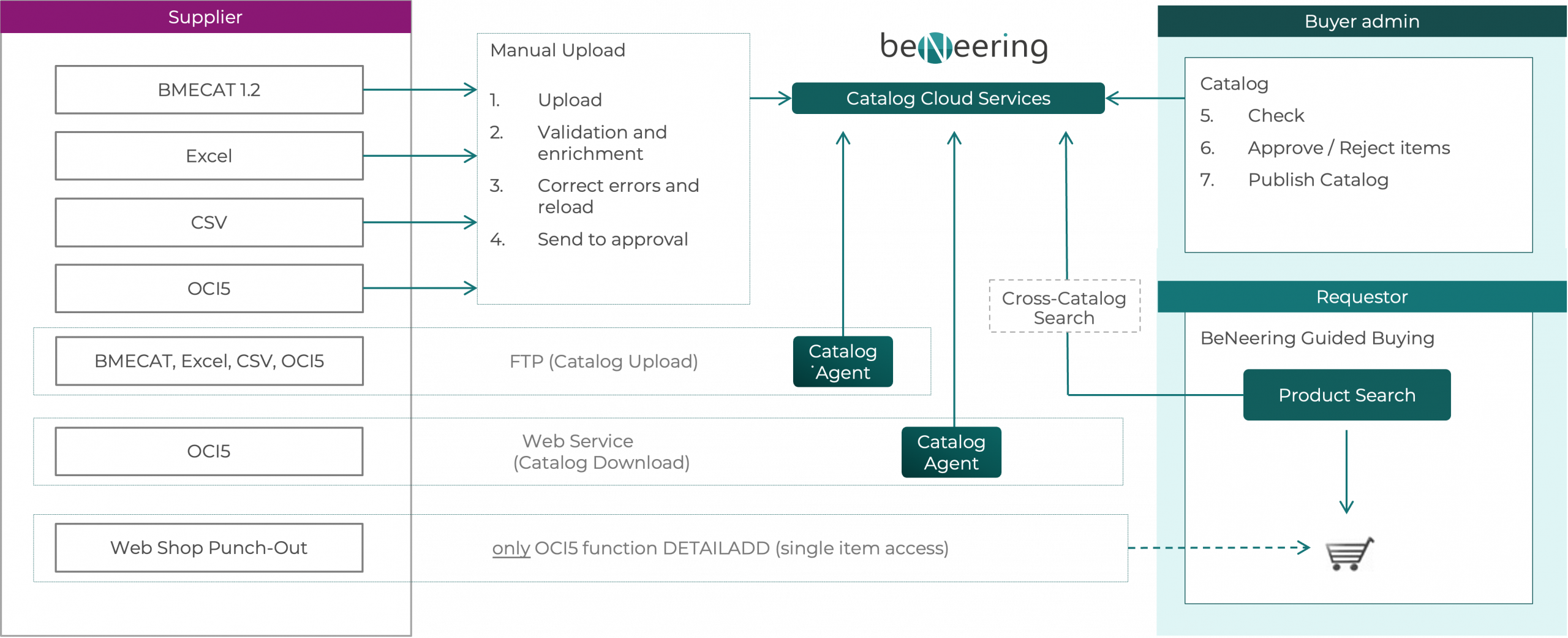
Supplier managed catalogs: one of the key features of our Catalog Management is the possibility for suppliers to update and manage their own catalogs via our Supplier Portal. BeNeering leads supplier onboarding.
Buyer managed catalogs: buyers have a possibility to create buyer (internal) catalogs to manage, for example, multi-supplier catalog.
SAP ERP DATA
Material and service master/ Contract data replication from SAP
If you want to order from own stock, order based on SAP materials and service masters or create a contract call off, SAP master data should be displayed in BeNeering. To ensure a smooth requestor experience SAP data becomes part of search content and is visible as any other item in “catalog-like” format.
Marketplaces & Punchouts
- Major marketplaces are fully integrated into BeNeering Guided Buying and their content is indexed for search from BeNeering UI
- Search query is sent to all authorized marketplaces and punchouts in parallel in real-time
- Single user interface for item search leads to no interruption in navigation
- Ordering with one-creditor model is possible
External Webshops
- Requestors can access external webshops through BeNeering
- Requestor has to choose the right webshop
Our partners












Key features
Content data validation and enrichment
Uploaded content run through over 250+ validation rules check, e.g. item short text description is no more than 40 signs in alignment with S/4HANA logic or price increase should not be more then 5% in case of catalog re-upload (items with bigger value should go through approval), and enrichment with, for example, SAP ERP data like supplier ID.
Multi-language concept, synonyms and key words
Content can be assigned with additional data like multi-language translations, key words for quick search and synonyms. BeNeering AI Engine adds intelligence on top with assigning additional key words and synonyms for a better search results.
Connection of marketplaces & external webshops
External catalog platforms can be connected via established integration standards and interfaces, including: OCI 4.0 / OCI 5.0 (Open Catalog Interface – SAP standard for integrating external catalogs and marketplaces); cXML (commerce eXtensible Markup Language) – frequently used for PunchOut catalogs and e-procurement solutions; marketplace APIs (REST-based)
Support of product relations
Bundled items are products or services sold together as a single offering. These items can be customized in different ways. Some related items can be marked as mandatory—for example, when a car must be linked to a required leasing contract. Other related items can be sorted into categories such as accessories, similar products, spare parts, or replacements.
Support of price calculation
Minimum order limit, price factor and price scales can be set up. This helps to better replicate the contract agreement and ensure contract compliance. The price conditions are visible to the requestor.
Support for specific item indicator and document attachments
Hazardous materials and substances can be marked with special indicator, and have obligatory documents attachments (technical data sheets, safety data sheets, etc.) in order to comply with legal requirements for occupational safety and workplace guidelines and to ensure safe, compliant processing and storage processes. Customers can also indicate eco, ESG, green items.
Content & Catalog Management Process
Benefits
Optimized spend
Thanks to full visibility into suppliers ordering trends duplicate suppliers and contracts become visible, opening an opportunity of spend and demand aggregation and supplier rationalization
Full control over suppliers’ conditions
No uncontrolled and unapproved changes in buying content are possible without procurement approval
Improved compliance
Full and automated control over items that users could request and purchase from various suppliers
Consistent user experience
Increased solution adoption thanks to unified and intuitive user interface, leading to bigger compliance and spend under management ratio